You are asking the wrong questions

  • 0

You are asking the wrong questions

Category:Opinion Tags : 

In our quests to get the right message out, we are trying to understand those we are targeting better. We use different strategies to get information that will help us do that.

When we turn to our (potential) customers for information it can get dangerous. And often it goes wrong.

It might seem like the right thing to do, asking your potential customer what they want. After all, it’s them we are targeting. Going to the source is the best way to get the right information. Or so we think.

In theory, this is correct. In practice, this often goes wrong, because of the way we ask the questions.

I’ve seen many surveys and client sessions fail because the wrong questions got asked. They are biased questions. Even though in some cases they might not seem so.

The way you ask the question influences the way people answer. Let me give you an (offline) example: asking kids a question.

If you have children in the age of my kids, 7, 9 and 11, you will recognize this. Some questions won’t get you a satisfying answer.

At all.

When you ask your kids “Did you have fun at school”, most of the time they will answer with a simple yes or no. If you then ask “Why”, the response will still be unsatisfying. They will answer something like “just because..” And then go silent again. A question like “How was school” will get you an answer in the lines of “OK”.

This can be a frustrating process.

But there is a different way.

When instead of “How was school”, you ask “Tell me about school”, the answers will change. Often the kids will start talking. They will tell you not just what happened, but also how they feel about it. I’ve seen many cases of this happening, not just with my own children.

When researching your customer’s needs, similar things can happen.

Often you will ask questions that will lead to a specific answer.

Asking the question “Do you like this product?” will often lead to the answer “yes”. You are pushing towards a specific answer here. It’s a closed question that will not lead to the right information. The same goes for questions like “How do you like our product?”. The answer there will be “fine” or “ok”, or similar.

Asking your customers to tell you about the product will give you much more valuable information. So instead of asking “How do you like our product?”, try asking “Tell me about this product”.

The information you will get will be 100x more valuable.


  • 0

The right content at the right time to the right audience: my talk at #theinbounder Valencia

Category:speaking Tags : 

Last week I presented at the Inbounder Conference in Valencia. It was the second time I was there. Last year one of my industry friends, Gianluca Fiorelli, organised the event for the first time. Then for about 150 people. This year, he outdid himself. Over a 1,000 attendees visited an amazing venue to listen to a list of top quality speakers.

Gianluca brought together ‘his friends’ for an epic two days in the “Ciudad de las Artes y las Ciencias”, the science museum, in Valencia. Great people, great content and what a venue!

Just take a look at some of the pictures:

I myself got to speak about content. I talked about how we are ‘polluting’ the web with so much bad content. Content that doesn’t make sense. It was a cry out for change. Not just create content because “Content is King”, but create content because it will help your audience and your business.

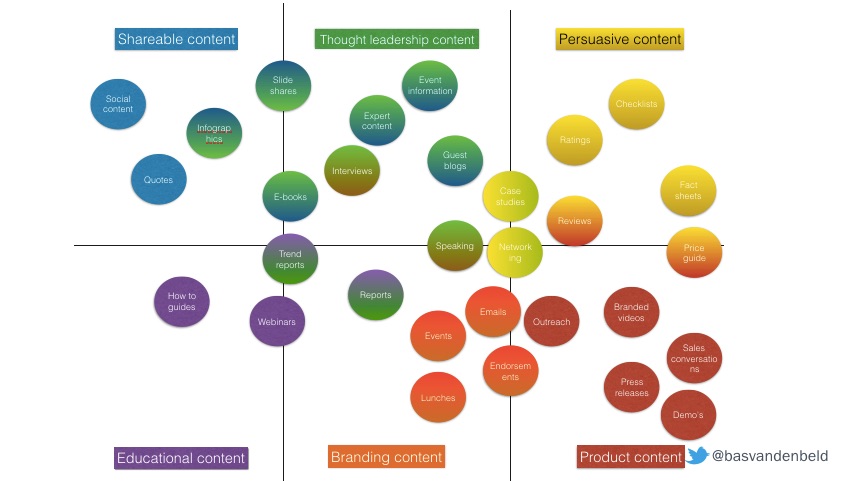
I am a strong believer in the principle of creating only what has a purpose. If a piece of content doesn’t have a purpose, it is useless. These purposes can differ. Content to give people a warm feeling of the brand. Content to education and content to persuade for example. This overview is important with that:

basvandenbeld-Valencia-Inbouder-2016-content-types

My deck with slides can be seen here:

Are you interested in learning more about this? Do get in touch, I offer different options to train or consult your organisation to get this done!

See for more training options here: http://www.basvandenbeld.com/training/


  • 2

I have a focus problem. Want to know how I deal with it?

Category:Tips Tags : 

I have a problem. I get distracted quite easily. And that is something which is not convenient for someone who works on his own.

Before you make too much out of this. I’m not distracted all the time. It’s not every day. And if I do get distracted, it is during certain times of the day. The afternoon to be specific. I’m great at focusing in the morning. I’m also great in the evenings.

I’m less great in the afternoon.

After lunch, my concentration goes to hell. I’ve lost many afternoons because of concentration dropping off.

This annoys me. A lot.

As a person who has too many things on his agenda anyway, you can see this could be a problem. Especially because I work on my own. If I don’t do the things that need to be done, nobody will. It’s the problem for a solo entrepreneur: finding the inspiration within yourself.

So I’ve started looking for solutions. And where do you go? You go to Google…

how_can_I_focus_better_-_Google_Search

The first thing I noticed: I am not alone here. There are tons of articles with solutions on the web. Written by people who have the same problem. But also by people who think they understand the problem and can help you. It strikes me that there are many people giving advice who clearly have no clue. Advise like “delete all your social profiles”, you can find more than often. It’s clear this comes from someone who has no idea what he or she is talking about. Who’s going to do that? Besides that it would kill my work, I wouldn’t want to.

Granted, there are some good ideas out there. I’ve tried many. But most ideas failed for me.

To name just a few:

  • I’ve tried to block websites and social profiles during certain hours. This to force myself to work and not get distracted. I just unblocked them…
  • I’ve tried a change of scenery. Working in libraries, different places in my house, cafe’s, you name it. It helped only a little.
  • I’ve tried to ‘meditate’ to clear my mind; I’m sorry, that’s just not me…
  • I’ve tried blocking my agenda for tasks; didn’t work for me, it just made my agenda fuller. And I wouldn’t stick to it.
  • I’ve tried to set hard deadlines for myself. To be honest, if it’s just you, deadlines are useless. You need others for this.
  • I’ve tried tracking how I spend my time. This just annoyed me even more, that is no solution, it’s just a reminder that you get distracted easily.

And these are just a few of the solutions I tried that failed.

So am I lost?

No. Far from.

Throughout the years, I’ve found a few things that work for me. And though I still have those days in which I can just ‘throw away’ the afternoon. I have become more focused.

Mind you, I’m not a completely focused person now. Unlike what some may try to make you believe, this kind of thing doesn’t go away. It’s something I (and I know many others) have to live with. The only thing I can do is reduce it. Make it less annoying. Hack my way around it. And sometimes even make use of it.

How Bas, tell me how!

I bet you’d like to know how I do this. Which tricks do I use?

Ok, I will share the things I do to make this less of a problem. Maybe they can help you as well. And of course, I’m curious about your solutions (that is if you have this problem).

Here we go

I make notes, lots of them

The first thing I do is making notes. A lot of notes. My mind always goes crazy because I have too many ideas and thoughts. A common way to get distracted is when you are reading. You read something, associate, and your mind wanders off on that topic.

One thing I learned from studying a lot of psychology in the past decade, is that your mind needs offloading. Writing things down means you take the pressure away. So I make notes. Whenever I read something or hear something in an audiobook or podcast, I write it down. I most often use Evernote for this so everything is stored there. But I also make a lot of notes on paper.

I go over these notes on a regular basis to make sure I do something with them. Writing them down makes me wonder off less often because my mind is clearer.

Evernote

I (try to) prioritize

One of my major problems used to be that I would get stuck in a task all day and forget about the stuff that is important. Funny enough I see this with my children when they are having dinner. If they have to eat something they don’t like, they will eat the things they like first.

That means at the end of the dinner, they struggle. They do not yet understand the idea of ‘save the best for last’.

I can do the same with work. The less important, often more fun, tasks, I do first. Making that I get in trouble at the end of the day, because I haven’t done the important stuff.

I’ve started to be more strict on prioritizing. Trying to do the hard stuff first. I have to admit, I still ‘slip’, but I’ve gotten better at it.

And the result is remarkable. Once I’ve completed the difficult tasks, I feel less stressed and happier.

It turns out that even though you are postponing, you are still thinking about it. Which makes it a struggle. The sooner you get rid of the struggle, the better you feel.

One way of prioritizing I’ve automated: my e-mail. I have tons of filters in my e-mail which makes that many e-mails go straight into a separate folder. Keeping my inbox relatively clean. This helps a lot to prioritize and stay away from reading and answering useless e-mails.

Time slots and small tasks

One thing I’ve learned is to use time slots. Not time slots that are on my agenda. That might work for some people (blocking your agenda for tasks), it doesn’t work for me. What I do is I break up my tasks into 25-minute blocks.

This means I work on something for 25 minutes and then stop. After the 25 minutes, I either take a break or do another task. I could also choose to add another 25 minutes to what I was working on. This is based on the Pomodoro technique. Which goes a bit further, planning wise.

For me, the planning didn’t work, but this works great. It makes that I am 100% concentrated for the 25 minutes.

TomatoTimer


Understand when to stop

One big thing for when struggling with the concentration: understand when to call it a day. Sometimes you just have to give in and stop. That’s right, just stop. Go have fun, do something completely different.

I’ve spent way too many afternoons trying to get my focus back. It didn’t work and made me frustrated. Instead now, I stop. I go have fun with my kids. Read a book. Or take a walk. It refreshes and when I am working next time. I go twice as fast.

Multitask

I know what you’re going to say here: multitasking is a myth. Especially for men. They can’t do it.

Wrong.

Multitasking is possible. You just have to know what to do. For example, I listen to a lot of podcasts and audiobooks to keep informed on developments. Now, this is something you can do with many things. Except for working. I can’t work and listen to a podcast at the same time.

But I can listen to a podcast and do the laundry for example. Or walk, run or drive. So I use that time efficiently and listen to podcasts while doing household chores. And it works! Whenever my focus is gone and I decide I need to stop, there is an alternative!

Music

This is a personal one. But music does help me to focus. But it has to be the right music. Sometimes I need music to wake me up. At other times, I need music to focus. When I want to get a lot of work done, I shouldn’t listen to sing-a-long songs. It should music I can concentrate with.

This means Spotify often saves my life. Or better said, it saves my focus. Spotify, of course, can give me any music I want. But the good thing about it is that I don’t have to choose if I don’t want to. Because they have “moods”. And guess what. One of the moods is… focus!

spotify

The tools I use

Oh yes, I definitely use tools to focus. Couldn’t live without some of them. A few I already mentioned. But let me sum up the most important ones for me:

Focus Writer

I’m writing a lot. And when writing you don’t want to get distracted by websites you might want to look at. Focus Writer helps me to focus on making sure I work full screen. I can’t see the other sites. There are more tools like this one, but I do like this one a lot.

_Untitled_4_

Tomato Timer

I mentioned the Pomodoro technique above. Tomato Timer helps me calculate the 25 minutes. Yes, you can do this with your phone, but the setup of this website is so simple, it is effective.

TomatoTimer-2

Evernote

Notes, notes, notes. To offload my brain, Evernote is very, very important for me.

Spotify

Finally Spotify. For my music of course :).

That’s it!

This is how I focus (more) than I did before. I realize I am not there yet. At all. I still ‘lose’ afternoons. I still get distracted. And it’s still difficult to make it work on your own.

But I do get stuff done. Working on your own is a struggle, but it’s amazing as well!

And now. You.

Now you owe me. I’ve admitted I have a problem. I showed you what I do about it. And I have given you tools to make life easier.

Now I want to hear from you. Comment and let me know how you keep focused. Help me and others with your way of working. And share of course. Tell the world. Because you know what….

EVERYBODY is struggling with this.

People that say they don’t are liars. It’s a universal ‘problem’ because we are people. So we need to share with others. Help each other. Everyone can then pick what works for them. And together we can get focused!

So, now. You. GO.


  • 0

Why I believe Digital Marketing Training is important

Category:Training Tags : 

When I was in college, my parents were sure: Bas will become a teacher. They thought a history teacher, after all, that was what I was studying. To be honest, it wasn’t too surprising they thought that. They were teachers themselves. My dad taught French and was a school principal. My mom was a grade-school teacher. Trust me, I could have filled a school with family members of teachers.

I didn’t become a history teacher. Although, I do use history a lot in my current roles. I didn’t even become an ‘official’ teacher on a high school. Maybe to the disappointment of my parents. I went into the internet business. That they didn’t foresee. For one because there was no such thing as the Internet when I started college. At least not as we know it now.

Life has its ways of turning things around. And as it turns out, more than 20 years after I was in college, I am a teacher. A different kind of teacher than thought maybe, but I am a teacher.

Much of what I do these days is teaching. Speaking at events is a way of teaching. Writing is a way of teaching. Even in consulting, I am teaching. And of course, the training sessions I do are teaching.

Instead teaching of high school students about history, I now teach grown-ups. I teach marketers, about digital marketing.

Some say teaching is the most important profession in the world. When people say this, they usually talk about high school and university teachers. And for the most part, I agree. Education is important. It helps make people better people. I also believe we shouldn’t just say this about teaching young people. This goes for the older generations as well. My grandma, (yes, the same one who taught me about marketing principles) until the day she died said she was learning every day. And it made her life better.

As someone now well in his 40s, I believe I should learn every day as well. Stay on top of things, get new ideas, new angles. I make an effort to learn every day. And to teach every day.

I believe there is a need for learning and teaching. Especially in the digital marketing space. It is such a fast changing industry that it is not easy to stay on top of things. It’s difficult to make choices without knowing the what is importance and what isn’t.

In Munich, I sat down with Gemma Birch from Webcertain for a short interview. She asked me about digital marketing training and the importance of it. You can see the interview here:

It’s a topic I am passionate about. For several reasons. For one, as said above, I believe people should always want to learn. Especially in a fast changing industry like ours. Also, I see a lot happening in this space. We see the rise of online training platforms like Udemy and Coursera. And we see a rise of webinars.

It is one of the things I am working on as well at the moment. As part of the bigger picture. I see many marketing departments struggling. Because there is a lack of direction and lack of understanding. Events, online training and face-to-face training. All are a big part of the solution for these businesses to move forward.

I’d love to know how your company looks at this. Do you train your people? Do you train yourself? And how do you decide where you need teaching? Let’s discuss!

And if you want to talk more, don’t hesitate to get in touch!


  • 0

The importance of mobile and the user perspective

Category:speaking Tags : 

Last week I spent a few days in Munich for the SMX Munich conference. It was a great couple of days for many reasons. I met up with some old friends I hadn’t seen in a while. I was able to connect with some new people and had a great time with some I speak more often. And yes, I spoke :).

In Munich, I shared a stage with Cindy Krum, who is the major authority on Mobile SEO. We talked about Mobile-Friendly User Experience. The session was a great one. I kicked it off talking about how to look at mobile and how people behave on mobile. In the presentation, I made sure to add some German statistics since after all we were in Germany. The slides can be found here:

I wrote an extensive post about my part on State of Digital here.

The importance of mobile

It’s evident that these days mobile is important. 8 out of 10 people now own a smartphone. And if you look at emerging markets, it’s mobile first all the time. So mobile is important.

However, I personally believe many look to mobile in a wrong way. They focus on the device first, the phone that is. Whereas looking at mobile is actually a lot more (as I describe in the talk and article).

Mobile is where people are. Knowing where people are is more important than the device they are on. If you understand they are on the move, you can create content that fits their needs. That’s even more important than the device (which can change).

This presentation fits into what I have been saying a lot in the past years. It’s part of understanding your customers. That also means it’s part of how you figure out what your audience wants and what content should be created to fit that.

Interested in finding out more about this? Get in touch!


Short bio

* Highly sought-after professional keynote speaker, trainer and strategist
* Awarded European Search Personality 2015
* More than 15 years of web experience
* Award winning consultant, trainer and professional speaker
* Founder of State of Digital
* Longer bio here